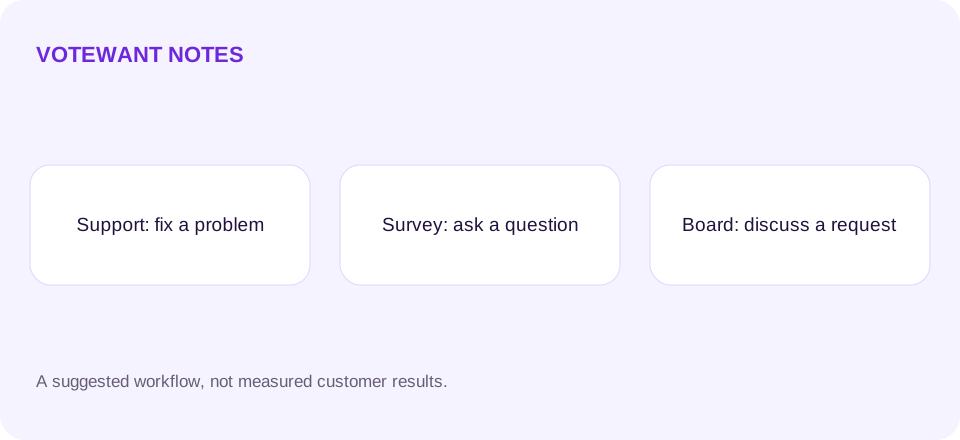

A feedback board is useful when people need to see, discuss, and support shared product requests. A survey is useful when you need responses to a specific question. A support inbox is useful when someone needs individual help. These tools overlap, but choosing one by the job it needs to do prevents a public board from becoming an exposed support queue.
For a small product team, start with the smallest arrangement you can maintain. One public board and one private support route can be more useful than several half-managed channels. The important question is where a person can leave the right information and receive a clear next step.
Start with the question you need answered
Use a board to discover recurring problems and let users add context to existing requests. Use a survey to ask a defined group a consistent set of questions. Use private support for account access, billing, security concerns, or anything involving personal records. A vote does not answer every research question, and a survey answer does not automatically become a product commitment.
Imagine a note-taking app. “Add offline search” belongs on a board because other people may share that need. “Why did you stop using search last week?” suits a focused research conversation. “My purchase disappeared” belongs in private support. These are illustrative examples, not VoteWant customer outcomes.
Make the handoff explicit
Tell users what the board is for before they submit. Ask them to describe the task, the obstacle, and the result they want. Give them a private route for sensitive details. When a support conversation reveals a broader product problem, write a separate, sanitized request with the user's permission where needed. Keep account details in the support conversation.
Link related discussions instead of making a person repeat everything. Explain that moving a general problem onto the board does not close their individual support case. A workaround, a product request, and a bug investigation can all exist at the same time.
Avoid treating visitors as a representative sample
Board participants are people who encountered the board and chose to respond. Their feedback is useful, but it cannot tell you what every user wants. Survey results also depend on whom you invited and who answered. Record the collection channel so a team can distinguish a request discovered in support from one suggested during an onboarding interview.
When you need depth, ask about a recent experience rather than whether someone likes a proposed feature. Nielsen Norman Group's user interview guide explains how open questions and careful follow-up support that research. A board is a starting point for those conversations.
Keep the next step small
For the coming week, choose one channel to review, one repeated problem to clarify, and one owner to respond. Measure whether requests contain enough context to make a decision and whether unanswered discussions are accumulating. Do not claim the board improved retention until you have evidence from the product itself.
VoteWant provides public request discussions and integration routes described in its widget documentation and API documentation. Explore VoteWant to see the current product. For the decision step after collection, read why votes should inform prioritization.