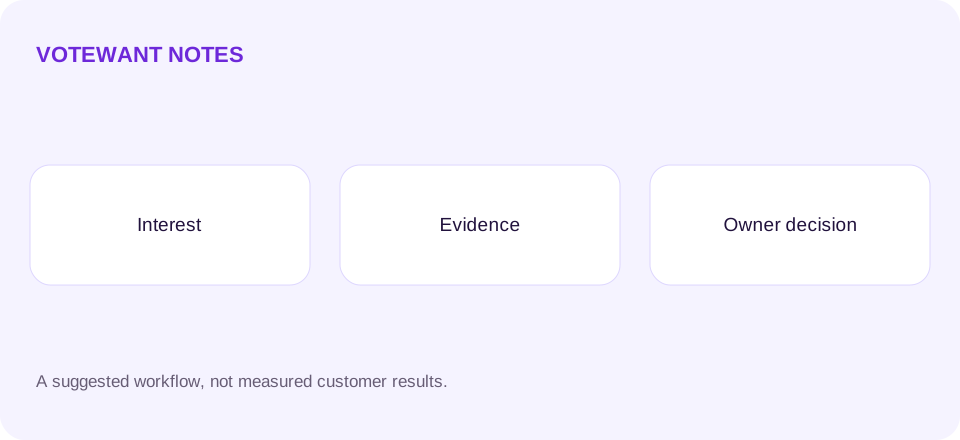

Feature votes help a team notice interest. They do not settle a roadmap by themselves. A popular request may solve a small inconvenience, while a less visible request may block a critical task. The useful move is to ask what each count represents and combine it with context before deciding what to build.
A public board can make this discussion visible. It should not imply that the largest number wins automatically. Tell participants how votes inform decisions, then explain the reasoning when a request moves forward or is declined. A clear process is more useful than a ranking that nobody understands.
Ask what a vote represents
A vote can mean “I need this now,” “This sounds useful,” or “I support the person who posted it.” A raw total cannot distinguish those meanings. Read the request and its comments before interpreting the count. Look for descriptions of a real task, current workarounds, and the cost of leaving the problem unresolved.
Provenance matters too. Anonymous participation lowers friction, but it carries different evidence from a verified external user. Internal suggestions and agent submissions need their own context. Keep those categories visible instead of adding everything into a single claim about customer demand.
Compare problems, not just proposed solutions
Consider two hypothetical requests. A cosmetic theme has 40 votes. A reliability issue affecting report exports has 6. Neither count proves priority. The team needs to understand how often each issue occurs, which users encounter it, what the product is trying to improve, and what the available fixes cost.
Ask the same questions for both requests. What task is blocked? What evidence supports that description? Is there a workaround? What can the team learn before committing? This makes the reasoning repeatable without pretending that a formula removes judgment.
Use comments to reduce uncertainty
When a request is vague, ask for a recent example. Avoid asking people to endorse your preferred implementation. “What happened the last time you tried this?” gives you better context than “Would an AI button solve it?” Nielsen Norman Group's interview guide describes the value of neutral questions and follow-up.
The next action may be a short investigation rather than a feature. Record what the investigation should answer. If the evidence remains weak, say what is missing. A request can remain open without becoming a promise.
Publish a decision that people can understand
When you change a status, add a short explanation of the scope and reason. A planned export improvement might cover a weekly summary, while excluding every possible custom format. A declined request may conflict with the product's purpose. Explain that tradeoff without dismissing the people who raised it.
Do not equate “planned” with a guaranteed date. Update the explanation if circumstances change. Read public roadmap statuses for wording that distinguishes investigation, commitment, and delivery.
Use VoteWant counts honestly
VoteWant's API documentation explains that install votes do not count as verified demand because installs can be reset. A stable anonymous label helps discussion and moderation; it is not proof of a unique person. Read anonymous feedback and spam before using those counts in a decision.
Explore VoteWant to collect requests, comments, and context. The owner still makes the product decision. Use the board to show the evidence and the reasoning that led to it.