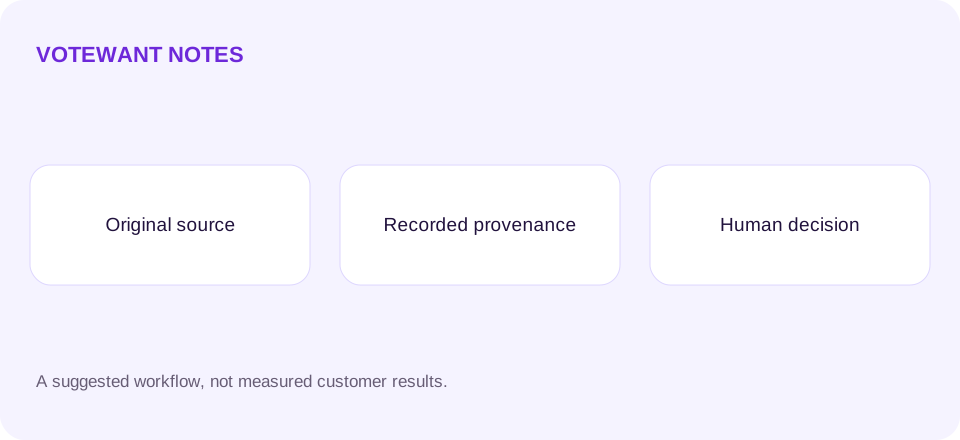

An agent can help organize product feedback, but it should not manufacture evidence that users asked for something. The useful role is to preserve a real source, summarize it accurately, and make the resulting request easier for an owner to review. The product decision still belongs to a person.
Before connecting an agent to a feedback board, decide which actions it may take and what evidence it must retain. Reading public requests, drafting a summary, and submitting an authorized request are different operations. Give each the permission it needs and no more.
Start with a real source
Keep the original message, conversation reference, or support summary available to the authorized reviewer. Separate the user's stated problem from an agent's interpretation. “The user cannot share the weekly report” is a different claim from “The user wants an automated reporting system.”
If an agent suggests a solution that nobody requested, label it as a suggestion. Do not attach invented quotes or imply that several users raised it. A useful summary can be concise while still distinguishing what happened, what the user said, and what remains uncertain.
Preserve provenance when submitting
VoteWant's API documentation describes owner-agent submissions with agent_on_behalf_of_human provenance and optional source channel, external ID, and HTTPS URL. That record explains how the request entered the board. It should not be rewritten as direct verified customer demand.
Be careful with source links that contain private information. A public request does not need to expose an internal support ticket or confidential conversation. Preserve the authorized reference where appropriate and write a sanitized public description. Do not use a public board as a replacement for a private support archive.
Keep owner credentials on the server
Owner automation uses scoped, revocable tokens. VoteWant's docs state that these tokens belong in a server-side secret manager, not a browser, app bundle, or game client. A public read client and an owner client have different authority.
Grant only the operations the workflow needs. If the agent is organizing requests, it should not need unrelated account or billing access. Existing tokens retain the scopes they were issued with rather than silently gaining new capabilities. Review the actual token scopes before expecting a newly added operation to work.
Make retries safe and review the response
Owner writes require an Idempotency-Key. Use a stable key for the same logical submission so a network retry does not intentionally create a second request. A new independent action should have its own key. Follow the endpoint's documented response and error behavior rather than treating every response as success.
After submitting, inspect the returned request and compare it with the intended title, body, board, and source. If the workflow reports an error, keep the source and draft available for review. Do not repeatedly submit with changing keys to force a result through.
Keep decisions visible and human-owned
An agent summary can help an owner find patterns, but counts still need provenance and context. Read feature voting versus prioritization before converting board activity into a roadmap. If the agent recommends a status change, explain the reasoning and let an authorized owner decide.
Explore VoteWant and its current API contract for the available operations. This workflow does not promise automatic roadmap decisions, automatic shipping, or a public package release. It describes how to use existing submission capabilities without losing the human intent behind the feedback.